

 Niko Lewman
In the Primary Years Programme (PYP), inquiry is the beating heart of our pedagogical approach. But how do we effectively map, monitor, and document the complex, non-linear growth of inquiry skills in our students? More importantly, how do we move students from simply doing inquiry to truly understanding how they learn?
This is where the Inquiry Learning Progressions come into play.
As defined in the official IB documentation, “Learning progressions describe how skills develop or how subject content develops in sophistication over time.” More than just a tracking mechanism, they are specifically designed to act as a bridge between the Approaches to Learning (ATL) and the Approaches to Teaching (ATT).
For PYP Coordinators and pedagogical leaders looking to meaningfully integrate these progressions into collaborative planning, here is a comprehensive, professional guide grounded directly in the framework’s core principles and real-world Program of Inquiry (POI) examples.
1. Establish Your Strategic Focus
Before bringing these tools into unit planning, schools must decide exactly how they will be utilized. Successful implementation requires intentional onboarding, clear expectations, and a culture of reflection.
As you guide your teaching teams, lead with reflective questions. The IB guidelines recommend asking:
- “For what purpose are you going to use the inquiry learning progressions?” * “How will you ensure enough time to engage with the inquiry learning progression(s)?”
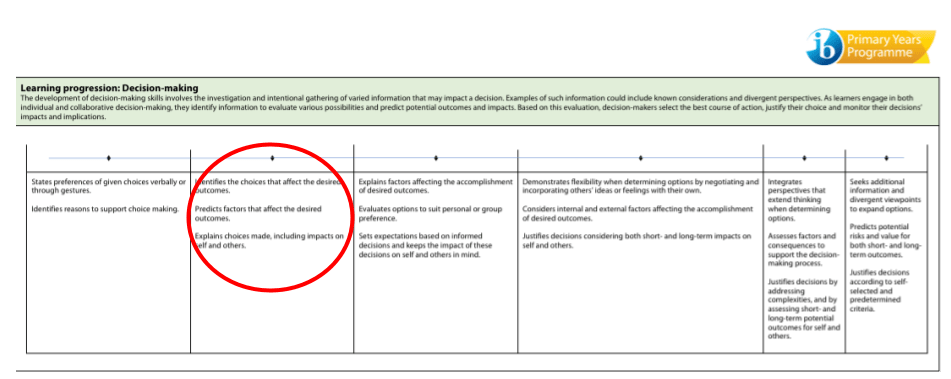
Action Step for Coordinators: Establish the scope of your rollout early. Decide whether engagement will initially be voluntary or mandatory. Determine if you will focus on one specific progression, such as Decision-making or Observation, as a whole-school focus before introducing others. A powerful starting point is to examine your school’s ATL vertical alignment. Identify which inquiry skill needs the most scaffolding across grade levels.
2. Bridge the “What” and the “How” Through Your POI
A common hurdle in collaborative planning is conflating curriculum standards with skill development. Coordinators must help teachers differentiate the what (the conceptual understandings) from the how (the inquiry process).
While the PYP subject continuums and your POI outline the learning outcomes students need to explore, the inquiry learning progressions support teachers in planning and documenting the underlying skills required for that learning.
Let’s look at how this maps directly to your Program of Inquiry:

EYC (How the World Works): Your central idea states, “People explore their surroundings with their senses.” Here, the Observation progression is paramount. Teachers can map how a student moves from “noticing, pointing out and stating what they see, hear, feel” in their immediate environment, to “grouping and stating what they see… using visible or identifiable concrete attributes.” The progression provides the exact language teachers need to document this growth.
- Grade 5 (Who We Are): Your dynamic unit focuses on: “Learning about identity enables us to develop an understanding of ourselves and our culture.” This is the perfect landscape for the Questioning to explore and play with ideas progression. A student operating at a high level of inquiry here isn’t just asking simple questions; they are “using questioning to explore and challenge diverse and novel perspectives.” The progression helps teachers design engagements where students must actively seek out divergent cultural narratives.
By utilizing these progressions, educators can intentionally design learning. This learning integrates inquiry skills within specific subjects. It also spans multiple transdisciplinary areas.
3. Explicit Gains: Transferring Knowledge to Metacognitive Understanding
The true magic of the inquiry learning progressions happens when we use them to build metacognition—when students become aware of their own thought processes. When students can explicitly name the ATL skill they are using and evaluate its effectiveness, they transfer knowledge into profound metacognitive understanding.
Coordinators can facilitate this by encouraging teachers to co-construct success criteria with students, directly linking daily activities to ATL skills. Consider these powerful examples of metacognitive transfer:
- Connecting Choices to Consequences (Decision-making): Instead of just telling students to behave, use “Role-Playing Scenarios” focused on social skills (expressing emotions, self-regulating, compromise). The metacognitive leap occurs when a student can articulate: “If I just grab the snack, my friend will feel sad. That’s a consequence. If I choose to ask to share it, the consequence is we both feel happy and respected.” They are verbally connecting the choice to the outcome, moving up the Decision-making progression by “explaining choices made, including impacts on self and others.”
- The “Repair Plan” Flowchart (Role- and Turn-Taking): When conflicts arise, guide students to use a Repair Plan. The metacognitive success criterion is met when a student can articulate what the “unkind” choice was (the cause) and describe how it made someone feel (the effect/consequence). They shift from relying on teacher mediation to “assessing strengths and opportunities for growth when negotiating group tasks and responsibilities.”
- The “Kindness Clinic” (Problem Solving & Communication): Challenge students to explain how their behavioral choices affect the learning environment. Success looks like a student suggesting a solution—“Maybe we could invite them to play with us”—and explaining the consequence: “That choice would make them feel included and help our classroom be a friendlier place.” This is the highest level of metacognitive reflection: seeing the impact of a personal choice on the wider community system.
When we make the invisible steps of learning visible, students become agents of their own inquiry.
4. Design Rich, Varied Learning Opportunities
The progressions are not just assessment rubrics; they are dynamic tools for lesson ideation. Teachers should be encouraged to leverage the “Sample learning opportunities” included in the IB framework to design a mix of unstructured, structured, free, and guided activities.
The progressions offer an excellent script for classroom facilitation and environmental design:
- For Questioning: Teachers can model inquiry by introducing “Wonder Walls” or purposefully phrasing prompts like, “What if we changed this material? What might happen?” * For Observation: Educators can plan sensory walks or object deconstruction activities, moving students from simply noticing concrete attributes to exploring abstract interconnections. For example, when looking at artifacts in a Where We Are in Place and Time unit, students can use thinking routines like See, Think, Wonder to bridge visible attributes with abstract historical concepts.
- For Role- and Turn-Taking: Teachers can use the progressions to help students navigate social dynamics. During a Grade 4 How We Organize Ourselves group project, teachers can explicitly guide students to transition from familiar “helper” roles to actively negotiating group responsibilities, ensuring that “others are included and can contribute, in order to enhance collective critical thinking.”
By framing discussions around these explicit indicators, teachers can push student thinking to the next developmental level.
5. Shift the Assessment Paradigm
Perhaps the most transformative aspect of the inquiry learning progressions is how they reframe assessment. “Inquiry learning progressions are not based on age or grade levels, and are not time-bound, unlike curriculum standards or achievement objectives.”
Because a single group of learners will naturally operate across multiple progression points at any given time, assessment must shift toward flexible pacing and individualized goal-setting. A student might be highly advanced in their Observation skills—easily categorizing abstract relationships—but require more scaffolded support in Role- and turn-taking during collaborative tasks.
The progressions allow educators to build a comprehensive “portrait of an inquirer” that clearly illustrates where the learner has been, where they are now, and where they are going next. By establishing this shared language, learning communities can successfully shift away from a deficit model (focusing on what learners cannot do) and fully embrace a model focused on continuous, personal growth and metacognitive reflection.
The Coordinator’s Impact
By intentionally embedding the inquiry learning progressions into your collaborative planning process, you empower your educators to move beyond simply teaching content. You give them the tools to make learning visible. In doing so, your teachers become true architects of inquiry, equipped to nurture, monitor, and celebrate the unique, metacognitive learning journey of every single student.
I have added here a presentation created with NotebookLM with this prompt:
Act as an expert IB PYP Coordinator and Instructional Designer. I need you to create a comprehensive outline and script for a 10-12 slide Professional Development (PD) presentation. The goal of this presentation is to introduce our teaching staff to the IB PYP Inquiry Learning Progressions, based entirely on the provided blog post source document ("Elevating Your PYP Planning").

The audience is PYP homeroom teachers and single-subject specialists. The tone should be inspiring, practical, professional, and collaborative.

Please structure the output so that for EVERY slide, you provide:
1. **Slide Title:** A catchy, clear title.
2. **Visual Idea:** A suggestion for what should be on the screen (e.g., a specific chart, an icon, a type of photo, or minimal text). Keep the on-screen text brief to avoid overwhelming the audience.
3. **Bullet Points (On-Screen):** 3-4 short phrases that will actually appear on the slide.
4. **Speaker Notes:** A detailed script for the presenter. This should elaborate on the bullet points, pull direct quotes from the source document, and include the specific classroom examples mentioned in the text.

Please ensure the slide deck follows this narrative arc:

*   **Introduction & The "Why":** What are Inquiry Progressions? (Explain how they bridge ATLs and ATTs) and why they are vital to our pedagogy.
*   **The Paradigm Shift:** Explain how these progressions change our view of assessment (not age-bound, no deficit model, building a "portrait of an inquirer").
*   **Bridging the "What" and the "How":** Explain the difference between the POI/Curriculum (the what) and the progressions (the how). **Crucial:** Explicitly use the EYC (How the World Works) and Grade 5 (Who We Are) examples from the text.
*   **Building Metacognition:** Dedicate 1-2 slides to how we use these progressions to make learning visible. **Crucial:** Explicitly include the "Role-Playing Scenarios", the "Repair Plan", and the "Kindness Clinic" examples from the text to show how behavioral choices link to metacognition.
*   **Actionable Classroom Design:** How teachers can use these tools to design rich learning opportunities (mention Wonder Walls, sensory walks, and adapting group roles).
*   **Our Strategic Focus/Next Steps:** How our school will roll this out practically (e.g., focusing on one progression like Observation or Decision-making first, co-constructing success criteria).

Make sure the speaker notes sound natural, encouraging, and ready to be read aloud to a room of educators.


